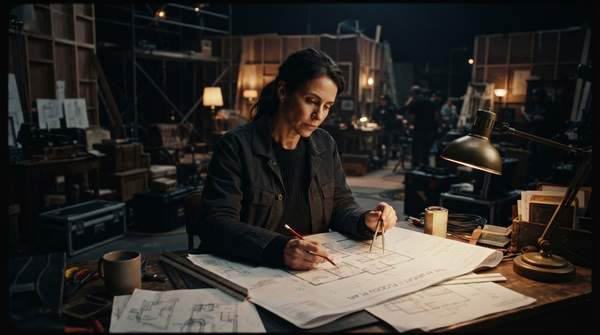
Before a single frame is shot, a production designer develops the entire visual concept for a film or television production. This comprehensive role includes generating detailed budgets, finding locations, and coordinating with nearly every department head, essentially building the film's world from scratch. AFI states production designers present designs to directors during pre-production and manage art department breakdowns. This establishes them not merely as artists, but as central project managers and visionaries for the entire visual production.
Production designers are the ultimate creative visionaries for a film's look, yet they are simultaneously deeply entrenched in the technical, logistical, and financial minutiae of bringing that vision to life. This dual burden makes them indispensable, though often underappreciated, architects of a film's tangible world.
Their role is far more expansive and critical than commonly perceived, demanding greater recognition for their foundational contribution to cinematic storytelling.
The Visionary Behind the Screen
Production designers translate a director's abstract ideas into a tangible visual world, beginning with script analysis to interpret narrative visual requirements. National Careers notes set designers read scripts and discuss the director's vision. This initial collaboration is crucial for translating a written story into a cohesive visual language, shaping mood and character.
The distinction between 'set designer' and 'production designer' often lies in scope. While National Careers uses 'set designer' for these responsibilities, AFI refers to 'production designer' for visual concept development and overall budgeting. This implies 'set designer' is a more granular, execution-focused term, while 'production designer' encompasses broader strategic and conceptual leadership for the entire visual world.
Beyond Aesthetics: Technical Mastery and Logistics
Beyond artistic conceptualization, the production designer's role demands extensive technical proficiency and meticulous project management. Responsibilities include drafting technical drawings using CAD software, specifying materials, budgeting, and scheduling. Assessment details these tasks for set designers, alongside conceptualization and supervising installation and strike. The requirement for 'drafting technical drawings using CAD software' reveals a highly technical, engineering-like precision. Designs must be buildable and adhere to financial and time constraints, requiring skills more akin to an architect or engineer than a traditional artist, bridging creative vision with practical execution.