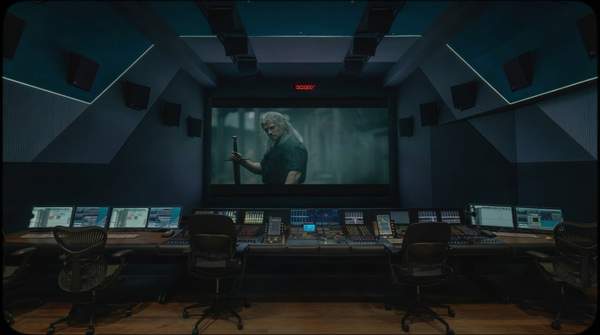
DaVinci Resolve 21 now includes over 100 new motion graphic effects and AI tools like CineFocus, yet its core version remains completely free for filmmakers, making advanced post-production accessible to a broader creator base.
Professional-grade filmmaking tools are becoming increasingly sophisticated and expensive on the hardware front, while equally powerful software solutions are available for free or at a one-time low cost, creating a significant divergence in industry trends. The tension between sophisticated, expensive hardware and powerful, free software highlights a shift in where innovation truly benefits independent creators.
Independent filmmakers can now achieve unprecedented production value in post-production without significant financial outlay, shifting the focus from hardware acquisition to creative skill and software mastery, while high-end hardware continues to serve specialized, large-scale productions.
1. DaVinci Resolve 21
DaVinci Resolve 21 serves independent filmmakers, editors, colorists, and motion graphics artists with a comprehensive, free post-production suite. Its free version supports UHD resolutions (3840x2160), while the $295 USD Studio version extends to 32K, according to Fluxnote. The software includes over 100 new motion graphic effects and AI tools like IntelliSearch and CineFocus, enhancing creative and workflow capabilities, according to Blackmagic Design. The accessibility of DaVinci Resolve 21 means professional-grade post-production is no longer limited by budget, democratizing high-end creative control.
2. Fujifilm X-M5
The Fujifilm X-M5 offers film students and independent creators high-resolution capture in an affordable, compact form factor. It records 6.2K open-gate video in 3:2, providing reframing flexibility in post-production. F-Log2 support maximizes dynamic range, as detailed by Digital Camera World. While its included XC 15-45mm kit lens has limitations like audible zoom noise, this camera lowers the entry barrier for high-quality cinematic acquisition.
3. Sony PXW-Z300 XDCAM Handheld AI-powered Camcorder
Sony's PXW-Z300 XDCAM handheld camcorder targets documentary filmmakers and journalists, offering AI-assisted capture and C2PA standard support for video authenticity, according to TVTechnology. The integration of AI-assisted capture and C2PA standard support provides verifiable content provenance at acquisition, crucial for journalistic integrity. Despite its higher cost compared to prosumer alternatives, it establishes a hardware-based foundation for trust in digital media.
4. Sony PTZ Auto-Framing Cameras
Sony's PTZ cameras, including models like the BRC-AM7, SRG-A40, and SRG-A12, receive firmware updates leveraging AI for auto-framing, according to TVTechnology. AI-powered auto-framing streamlines multi-camera setups for live events or studio productions, allowing a single operator to manage complex shots. While requiring specific hardware investment, these cameras significantly reduce crew size and enhance operational efficiency.
5. Sony Authenticity & Provenance Workflow
Sony offers an end-to-end workflow for content authenticity and provenance, crucial for news agencies or legal documentation. The end-to-end workflow integrates hardware like LiveU TX1, PDT-FP1, and PWA-RXS, according to TVTechnology, ensuring a secure chain of custody from capture to distribution. The comprehensive, albeit complex and costly, system establishes a verifiable origin for high-stakes digital media.
6. DaVinci Resolve 21 IntelliSearch
IntelliSearch, a new AI tool in DaVinci Resolve 21, enhances media management for editors and producers, according to Blackmagic Design. It allows intelligent searches within footage, streamlining content discovery and workflow efficiency in the free software suite. IntelliSearch's integration proves AI's value extends beyond creative effects to fundamental production organization.
7. DaVinci Resolve 21 CineFocus
CineFocus, another AI tool in DaVinci Resolve 21, offers filmmakers advanced control over depth of field and focus in post-production, according to Blackmagic Design. CineFocus enables creative focus alterations or corrections after filming, democratizing complex optical effects without specialized lenses or camera rigs.
Free vs. Studio: When to Upgrade for Professional Demands
While the free version of DaVinci Resolve 21 offers substantial power, the Studio version unlocks advanced capabilities like 32K resolution for a modest one-time investment, standing in contrast to the significant cost of specialized hardware like the PXW-Z300.
| Feature | DaVinci Resolve 21 (Free) | DaVinci Resolve 21 (Studio) | Sony PXW-Z300 (Hardware) |
|---|---|---|---|
| Resolution Support | Up to UHD (3840x2160) | Up to 32K | Specific camera resolution (e.g. 4K) |
| Price | Free | $295 USD (one-time) | High (hardware purchase) |
| AI Tools | IntelliSearch, CineFocus, 100+ effects | All free features + advanced AI processing, multi-GPU support | AI-powered capture, auto-framing |
| Motion Graphics | Over 100 new effects | All free effects + advanced Fusion capabilities | N/A (capture device) |
| Authenticity Support | N/A (post-production only) | N/A (post-production only) | C2PA standard support |
| Target User | Independent filmmakers, students | Professional studios, high-end post-production | News, documentary, verifiable content |
The Enduring Edge of High-End Production Hardware
Despite accessible software, high-end hardware innovates with advanced imaging and AI-driven automation for demanding production environments. Sony, for instance, will showcase its new 'R Series' system camera range at the 2026 NAB Show, designed to enhance image performance and system expansion, according to TVTechnology. Such hardware development addresses specialized needs software alone cannot fully meet, maintaining focus on capture quality and operational efficiency in large-scale productions.
Ensuring Authenticity in a Digital Age
The increasing sophistication of AI tools in post-production, like DaVinci Resolve's CineFocus, alongside hardware-based authenticity standards such as C2PA, suggests a future where content creation faces a growing tension between creative manipulation and verifiable provenance. If this divergence continues, the industry will likely see a greater demand for clear standards on disclosing AI-generated or altered content, particularly in journalistic and documentary filmmaking.