Hybrid film production is the strategic integration of traditional live-action filmmaking with advanced digital technologies across the entire production pipeline — not a single tool, and not a distribution model. As defined by the Creative Handbook, a Los Angeles industry directory, it is a "connected pipeline where real world talent and craft are amplified by digital capabilities to create a flexible, scalable production system." In practice, that pipeline has three distinct stages: pre-production visualization with digital twins, on-set virtual production with LED volumes and real-time rendering, and post-production AI enhancement layered onto live-action footage. Products announced in late 2026 — Topview's Film Studio and the pre-production tool CineTwin — illustrate the post-production and pre-production ends of that workflow.
What Is Hybrid Film Production?
The term describes methodology, not a market segment. Creative Handbook frames it as bridging "the gap between physical and digital," with real performers and craftspeople working alongside digital capabilities rather than being replaced by them. An industry report on Topview's Film Studio, which its maker claims is the world's first hybrid film production platform, captures the same idea from the product side: "the platform lets filmmakers combine live-action performances with AI-generated environments, shots, and visual effects."
Two distinctions matter. First, "hybrid" here refers to production technique, not the hybrid theatrical-streaming distribution strategies studios discuss. Second, the concept spans the whole workflow. As coverage of cinematography in VFX Voice notes, visual effects specialists who were once "sequestered to post" now work alongside cinematographers, set designers and other crew from the earliest stages — the defining feature of a hybrid pipeline is that digital expertise moves upstream into every phase.
The Hybrid Film Production Pipeline Explained
The framework below maps the three core technologies of hybrid production onto the three stages of a film workflow, with the example tools that evidence each stage. The mapping is the analytical point: hybrid production is what happens when all three stages are connected into a single system rather than siloed.
| Stage | Core Technology | Example Tool | What It Does |
|---|---|---|---|
| Pre-production | Digital twin / visualization | CineTwin | Build and test the entire production setup — cameras, rigsging, lighting — virtually, before anything is physical |
| Production | Virtual production (LED volume + real-time engine) | ILM StageCraft; Unreal Engine planning | Render environments in real time around live actors; directors and talent see the final output in real time |
| Post-production | AI enhancement | Topview Film Studio | Combine live-action footage with AI-generated environments, new camera angles from existing footage, relighting, and AI extras |
Read the table as a sequence, not a menu: the digital twin tested in pre-production becomes the environment rendered in the volume during production, and the resulting footage becomes the input that AI tools enhance in post. Each stage feeds the next, which is what turns three separate technologies into one "hybrid" system.
Pre-production: Digital Twins and Visualization
CineTwin 1.0, profiled by Newsshooter's Matthew Allard, is a full 3D application with its own stochastic renderer that lets a crew "build an entire production setup in detail," including mechanical components — truss systems, for example — that "work just as it does in the real world," and it "accurately visualizes lighting and what the camera actually sees." The point of a digital twin is decisions made upstream: if the camera position, lens and lighting plot are validated virtually, fewer expensive mistakes survive to the set. The Newsshooter account is candid about limitations too — the application still needs a large library of 3D assets, with modeling handled through a Blender integration.
Production: Virtual Sets and Real-Time Rendering
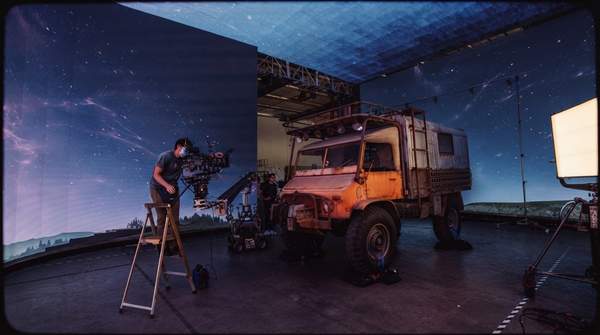
The production stage is where hybrid production went mainstream. VFX Voice traces it to Industrial Light & Magic's StageCraft system, which debuted on Disney+'s The Mandalorian: large-scale LED volumes replace static green screens, with real-time engines like Unreal Engine rendering environments around live actors. Crucially, as the same publication reports, this put cinematographers "at the center of virtual production," particularly in sci-fi, fantasy and other VFX-heavy genres, because the digital and physical image-making decisions now happen together on set rather than being deferred to post.
Creative Handbook's industry overview describes the current generation of these tools — AI-enhanced virtual set systems that integrate live compositing with Unreal Engine so "directors and talent can see the final output in real time," with built-in camera moves and environment changes measured in minutes rather than hours.
Post-production: AI Enhancement and Visual Effects
Topview's Film Studio, announced in November 2026, is the clearest current example of AI at the post stage. Its reported capabilities go beyond conventional VFX tooling: users can generate new camera angles and shots from existing live-action footage, add AI-generated extras to scenes, and use a "Video Relight" system — a 3D lighting tool with a real-time plaster-sphere preview so users can see how lights will look before generating, rather than iterating blindly. The relighting feature in particular blurs the pre/post boundary: lighting decisions that once belonged to the set can now be revised after the fact.
Key Benefits of Adopting a Hybrid Approach
Creative Handbook enumerates the business case: cost and time efficiency, because "shifting cost intensive decisions upstream reduces travel, logistics, and lengthy post production cycles"; effectively unlimited locations, since crews can "shoot in Tokyo, Paris, and Mars all before lunch without flying across the world"; and multi-format scalability, with TV spots, social cutdowns and branded content all derived from a single master production.
Creative flexibility shows up in the testimony of working cinematographers. The Last of Us cinematographer Catherine Goldschmidt told VFX Voice the volume let her hit a specific time of day in a long scene that "couldn't possibly get during the magic hour window" — the real dusk replaced by a controllable one. Her account also carries the honest counterweight: on Season 2, the volume sets were torn down for "pure economics" when the TV schedule didn't allow the in-camera effects to be finished in prep, leaving the crew paying twice — in prep and again in post. A hybrid pipeline is a commitment, not a discount.
On the market-access side, Topview's chief executive argues that "by adopting a hybrid production model that combines real actors with AI enhancement, filmmakers can create work that is accessible to Hollywood's mainstream distribution channels and better positioned to generate revenue" — a company claim about the model's commercial upside, not an independent finding.
Evaluating Hybrid Production for Your Project
Filmmakers should consider a hybrid production approach — matching each stage of the pipeline to a project's actual constraints — to capture benefits including efficiency, creative flexibility and scalability, while weighing Goldschmidt's caution that hybrid methods require prep time to pay off.
The measurable indicators of a successful adoption are concrete: reduced production timelines as cost-intensive decisions move upstream, expanded creative options such as shooting "magic hour" scenes at will in a volume, and broader market accessibility for the finished film through AI-assisted post-production. A project that ends up spending twice — once to prepare in-camera effects and again to fix them in post, as Goldschmidt describes — is the failure mode to watch for. This article explains the concept rather than providing a hands-on tutorial; Topview Film Studio and CineTwin serve as illustrative examples of their stages, not an exhaustive market survey or a product comparison.
Sources
- What is Hybrid Video Production? The Future of Filmmaking — Creative Handbook\ />
- World’s first hybrid film production platform debuts - TVBEurope
- CineTwin 1.0– a visualizer and digital twin for film & still photo productions - Newsshooter
- THE FUTURE OF CINEMATOGRAPHY: THE RISE OF THE HYBRID DP — VFX Voice