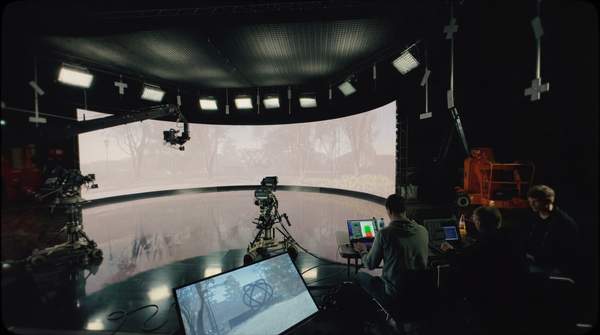
The TV show 'Fallout' secured an unprecedented $166 million in state funding for its third season in Los Angeles, a sum dwarfing prior incentives and revealing the escalating cost of attracting major productions (theguardian). $166 million in state funding for 'Fallout' signals a growing reliance on government subsidies to secure projects.
Despite this, Los Angeles on-location production activity increased 10.7% in Q1, reaching 5,121 Shoot Days (FilmLA). The 10.7% increase in Q1 growth, however, is heavily subsidized by record state tax credits, masking a recent decline in the region's overall production share.
Q1 numbers offer a temporary reprieve, but Los Angeles's film industry appears increasingly dependent on substantial government incentives to maintain production volume, indicating a fragile recovery rather than a robust resurgence.
Feature Films Drive Q1 Growth
Feature film production in Los Angeles recorded 687 shoot days in Q1, a 45.2% increase over the prior quarter and 52.3% year-over-year (MyNewsLA.com). The surge in feature film activity, with 687 shoot days in Q1, largely accounts for the overall 10.7% increase in Q1 on-location production (FilmLA). The data suggests a concentrated rebound in feature film activity, rather than broad industry growth.
Tax Credits Drive Relocations
CBS's "Tracker" will relocate from Canada to Los Angeles for its fourth season, a move facilitated by a $48 million tax credit from the California Film Commission (MyNewsLA.com). The $48 million tax credit directly influences production decisions, showcasing California's aggressive strategy to attract and retain major series. The relocation suggests that without such significant financial inducements, these productions would likely remain elsewhere.
Escalating Incentives, Fragile Gains
The $48 million credit for "Tracker" marks the largest award for a relocating series (MyNewsLA.com). The $48 million credit for 'Tracker', combined with 'Fallout's' $166 million for its third season (theguardian), demonstrates an unprecedented escalation in state funding. The record incentives of $48 million for 'Tracker' and $166 million for 'Fallout' reveal the high cost of attracting major productions, suggesting California is buying back market share rather than fostering organic growth. The strategy appears unsustainable, as it requires increasingly larger subsidies to compete with cheaper locales.