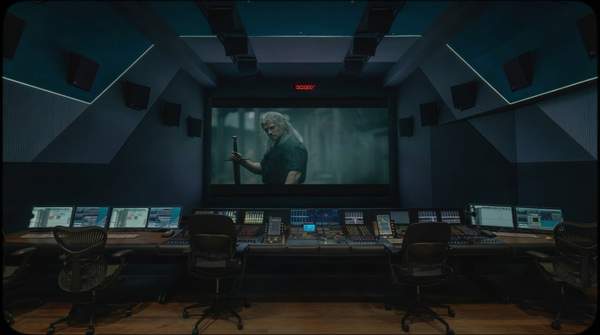
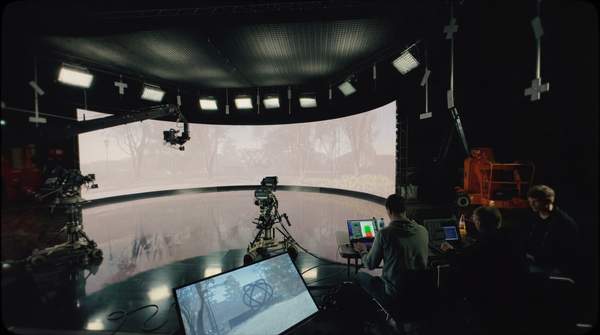
At the 2023 Tribeca Film Festival, 'Dreams of Violets,' a 75-minute drama, became the first fully AI-generated live-action feature accepted at a major festival. The acceptance of 'Dreams of Violets' at a major festival marks a new era for cinematic creation, integrating artificial intelligence into core creative processes. The film, 80% AI-generated, recreated actual anti-government protests, showcasing AI's capacity to simulate human experience and challenging authentic storytelling. Filmmakers now leverage AI for unprecedented creative expression and efficiency. However, this rapid adoption faces significant resistance, fueling fears of job displacement and artistic devaluation. The industry is on the cusp of a profound transformation, where AI will redefine creative processes and economic structures. This will likely lead to a bifurcated future of highly automated productions alongside niche, human-centric artistry, with significant labor market disruption. Authorship and production paradigms are already shifting, forcing a re-evaluation of human-machine collaboration.
The AI-Powered Creative Surge
The entertainment industry embraces AI to enhance creative output and streamline workflows. Steven Soderbergh used Meta's AI programs for surreal graphics in his documentary 'John Lennon: The Last Interview', according to AP News. Soderbergh's application of AI proves its utility in developing unique visual styles, expanding aesthetic possibilities for filmmakers. The World AI Film Festival (WAIFF) showcases films with AI-generated content, from fantastical to dystopian, as reported by The Guardian. The early adoptions by Soderbergh and WAIFF unlock new visual styles and production methods, pushing cinematic boundaries. The implication is that AI is not merely a tool for efficiency but a catalyst for entirely new forms of visual storytelling, challenging traditional creative workflows.
The Human Backlash and Regulatory Pushback
Despite creative advantages, AI integration faces substantial resistance from human creatives and labor organizations. SAG-AFTRA reached a tentative agreement with studios, establishing AI guardrails for digital replicas and synthetic performers, according to AP News. The SAG-AFTRA agreement addresses industry-wide concern over job displacement and the need to protect human talent. The Cannes Film Festival banned AI from its Palme d'Or competition, citing AI's inability to feel deep emotions, according to The Guardian. Cannes' purist stance directly contrasts with Tribeca's acceptance of an AI-generated drama, revealing a critical industry schism over artistic legitimacy. Three-fourths of entertainment leaders surveyed indicated AI tools supported job elimination or consolidation, according to hollywoodreporter. The survey data confirms that while AI offers efficiencies, the human core actively pushes back against unchecked integration, fearing job loss and artistic control. The implication is that without clear ethical frameworks and robust protections, AI's widespread adoption will exacerbate labor tensions and deepen the divide over artistic integrity.
The Economic Undercurrents: Investment and Automation
AI integration in filmmaking is driven by substantial financial investments and automation. Google DeepMind invested $75 million into A24 for AI filmmaking tools, according to TechCrunch. Google DeepMind's $75 million investment prioritizes technological advancement and efficiency over traditional human-centric production, reshaping the creative pipeline. Concurrently, AI talent studio Xicoia unveiled Tilly Norwood, an entirely photorealistic AI actress, according to forbes. The emergence of AI-native talent studios and significant investments indicates a strategic shift by tech giants and studios to leverage AI for cost reduction, scalability, and new revenue streams. With three-fourths of entertainment leaders already using AI for job elimination or consolidation, and the rise of AI actresses like Tilly Norwood, the industry is actively dismantling traditional human roles. SAG-AFTRA's guardrail agreements appear a belated attempt to regulate a runaway train. The implication is that these economic forces will fundamentally alter labor markets, creating a demand for new, AI-centric skill sets while displacing established roles.
Navigating the Future of Storytelling
Widespread generative AI adoption by major studios, alongside ethical complexities of AI-recreated events, challenges authorship, authenticity, and reality in film. Disney's Marvel Studios used Generative AI for the opening of its 2023 Disney+ show 'Secret Invasion', according to forbes. Disney's Marvel Studios' use of Generative AI highlights AI's increasing role in creative elements. 'Dreams of Violets', accepted at Tribeca, recreated 80% of actual anti-government protests in Iran, according to The Guardian. 'Dreams of Violets'' capability to simulate real-world human experience raises profound ethical questions about historical representation and factual accuracy. The implication is that as AI blurs the lines between reality and simulation, the industry must develop new frameworks for ethical content creation and audience trust, or risk undermining the very foundation of narrative credibility.
By the end of 2026, the ongoing investments from entities like Google DeepMind into A24 will likely solidify AI's position as an indispensable tool in major studio pipelines, forcing a re-evaluation of traditional production roles and accelerating the shift towards automated creative processes across the entire filmmaking spectrum.