Experienced and award-winning writers, directors, and producers are now paid as little as $12 per hour to train the very AI models threatening their careers, The Guardian reports. This compensation, up to $200 per hour, is a drastic drop for professionals whose expertise typically commands far higher rates.
The entertainment industry aggressively adopts AI to boost efficiency and cut costs. But this comes at the expense of thousands of jobs and the devaluing of human creative talent. Entertainment jobs in 2024 remained 25% below their 2022 peak. Studios have not replaced 18,000 full-time positions lost since 2022, riotimesonline reports.
Given AI's rapid adoption for cost reduction, coupled with declining traditional entertainment jobs and box office revenue, the industry appears poised for a leaner, more automated future. Human creative roles face increasing marginalization or redefinition, fundamentally reshaping film and TV company finances by 2026.
The New Economic Reality of Hollywood
The U.S. and Canadian box office grossed $8.7 billion in 2024, a 23.5% decline from 2024's $11.3 billion, riotimesonline reports. This revenue drop confirms a deepening financial crisis within the entertainment sector. Studios face intense pressure to adapt their financial models. The industry's pursuit of cost savings, driven by this decline and the promise of 20-50% cheaper hybrid AI films, positions AI as a critical tool for survival, not merely an innovation. This shift risks accelerating a race to the bottom, where artistic integrity is sacrificed for financial solvency.
AI's Rapid Infiltration and Strategic Deployment
- 300 — Netflix is projected to use AI in 300 of its 1,000 titles in 2026, according to The Guardian.
- 70% — 70% of major studios are using AI to predict box office performance and tailor content, according to riotimesonline.
These figures confirm AI is no niche experiment; it is a mainstream, strategic solution rapidly integrating into core business and production planning. This swift integration into production marks a fundamental shift from human-centric to AI-augmented or AI-driven content creation, moving beyond mere efficiency tools.
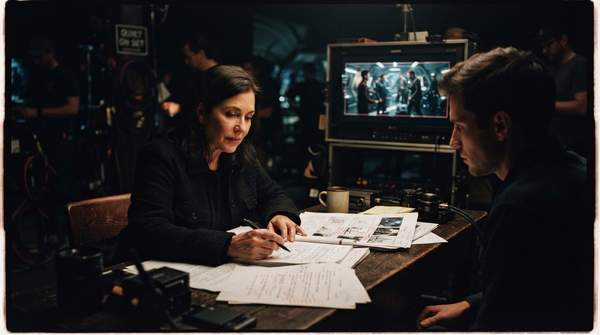
From Manual Craft to Algorithmic Efficiency
| Production Type | Estimated Cost |
|---|---|
| Conventional Production | Higher |
| Hybrid AI Film | 20% to 50% cheaper |
The significant cost reduction for hybrid AI films, estimated at 20% to 50% cheaper than conventional production by The Guardian, confirms a fundamental shift in production economics. This efficiency makes content creation faster and significantly more affordable. The implication is clear: studios can now bypass traditional human-intensive processes, potentially flooding the market with lower-cost content. This economic leverage fundamentally alters the bargaining power of human creatives, who now compete against algorithms that demand no salary or benefits.
Who Benefits and Who Bears the Cost
An executive producer at Obsidian estimated AI technology delivered a 30% to 40% cost saving, The Guardian reported. This substantial financial benefit directly incentivizes studios to integrate AI further. By failing to replace 18,000 lost full-time positions since 2024, while simultaneously paying experienced creatives as little as $12 per hour to train AI, major studios are not just cutting costs. They are actively dismantling the human creative infrastructure that historically defined the industry, converting talent into a disposable resource for algorithmic development.
The Global Response to an AI-Driven Future
France and South Korea will co-chair a summit on how the film industry should respond to artificial intelligence, compete with social media platforms, and cope with funding shortages, Bilyonaryo reports. This initiative confirms a global recognition of AI's profound challenges, signaling a collective effort to navigate its impact on the cultural and economic fabric of film. While governments seek protective solutions, studios have already implemented their own, potentially destructive, 'solutions.' Riotimesonline reports 18,000 full-time positions lost since 2024 remain unfilled. This reveals a significant disconnect: proactive, protective discussions at a governmental level clash with the reactive, cost-cutting measures already underway by major studios. The industry's pursuit of AI-driven cost savings is not just displacing human creatives; it actively exploits their expertise to build the very systems that will devalue future content, creating a self-defeating cycle of artistic erosion.
By Q3 2026, major studios like Netflix and Obsidian are projected to face increased scrutiny regarding their AI adoption strategies and the long-term impact on creative talent, especially if the 18,000 lost jobs are not addressed.